Showing posts with label Endemic. Show all posts

Friday, 9 September 2016

Why is endemism important ?

Endemism as Wikipedia puts it can be defined as an ecological state of a species being unique to a defined geographic location, i.e. an island, nation, country, range, zone or a particular habitat type. The Western Ghats of India is a hotspot for endemic birds with close to twelve species being found only here and nowhere else in the world. The Ghats un along the western edge of the Deccan plateau in Peninsular India starting just north of Bombay and ending in the south at the tip of the peninsula. Most of the endemics can be found distributed in highly restricted localities in the states of Maharashtra, Goa, Karnataka, Kerala and Tamil Nadu, although a few of these restricted-range species have also recorded from disjunct localities in the hills to the east, in northern Tamil Nadu and southern Andhra Pradesh. The levels of endemism among these restricted range species varies to a great deal with seven out of the sixteen endemics being found from sea level to c. 1500 mtrs across the Ghat ranges. While some species like the White-Bellied Shortwing can be found mainly above elevations of 1500 mtrs and in select patches in these hills. Another bird that is hard to come across and can be found only in select locations is the Black and Orange Flycatcher.
                                 

The Nilgiri Flowerpecker, endemic to the Western Ghats, but found distributed across a wide area.  (©Joiston Pereira)
https://www.facebook.com/Pixelsfromthewild/- More Images

The question then arises as to why endemics are so important to an ecosystem. Endemic birds are extremely selective in their habitat preferences and minor changes in their habitats will have cascading effects on the distribution and population of these birds. For example birds that are restricted to selected patches and colonize the moist understory, prefering a particular micro-climate will be most susceptible to the effects of climate change when compared to other endemics that are widespread across the Ghats. In the case of restricted endemics such as the Shortwing or the Black and Orange Flycatcher, the slightest alteration in habitats as a result of anthropogenic activities or global climate change will lead to severe declines in populations. Therefore these birds can help serve as indicators for the health of an ecosystem.

Image result for black and orange flycatcher
Black and Orange Flycatcher

Image result for ultramarine flycatcher
Ultramarine Flycatcher- another endemic from the Ghats.


Certain birds such as the Shortwing and the Broad tailed Grassbird can be found only in certain locations in the Ghats such as Grasshils in Ooty, the Avalanche hills, Peppara hills, and a handfull of other sites. With such varying levels of endemism, it is possible to determine the effect of habitat fragmentation, climate change as well as indirect effects of human presence in these previously untouched areas of the Ghats. The level of endemism exhibited by a species also helps to understand the specialist nature of its habitat preference as well as to create a map of the endemic birds and their exact distributional ranges in the Ghats. Current efforts are on to create a map of the various populations of endemics which would provide an exact picture of the level of endemism being exhibited by various species as well the size and distribution of specific populations.


Among the endemic birds, some such as the Malabar Grey Hornbill, Malabar Parakeet, Heart Spotted Woodpecker, etc can be found distributed across a wide area in the Ghats with populations from Tirunelvelli in the south to Bhigwan in the north, successfully being able to colonize the landscapes across the three major geographical gaps (see Mind The Gap). While some species have been unsuccessful in dispersing across these gaps owing to the specialist nature of their habitat preferences. 


Heart SPotted Woodpecker (L) and Malabar Grey Hornbill(R)
https://www.facebook.com/Pixelsfromthewild/

Endemism therefore it would seem is important to determine the effects of habitat modifications, adaptations, distributional patterns, etc that may be influenced due to anthropogenic pressures or due to climate change events. It is after all a criteria for evolution, and if 'survival of the fittest' doesn't go in favor of these birds, we can very well say goodbye to some spectacular winged jewels of the hills.


Tuesday, 30 August 2016

Endemic birds from the Western Ghats

                                 Isolated but not alone?


The "Sahayadris" as they are locally known are the largest range of mountains in Southern India. The Ghats run through seven states in the southern peninsula- Gujarat, Maharashtra, Goa, Karnataka, Kerala and Tamil Nadu and finally ending at Kanyakumari, the southernmost tip of India (Vijayan, V.S, 2007). These hills run for over 160,000 sq kms before and are responsible for the south west monsoons. The mountains block the rain clouds that come across from the Arabian Sea and it is this yearly phenomenon that is responsible for the formation of seasonal streams.


The Western Ghats of India, a biodiversity hotspot and a UNESCO world heritage site.

This area is one of the world's ten "Hottest biodiversity hotspots" containing over 7,402 species of flowering plants, 139 species of mammals, 508 bird species, 1,814 species of non-flowering plants, 179 amphibian species, 6,000 insects species and 290 freshwater fish species. It is estimated that over 325 threatened species call these Ghat ranges home. There is also a high possibility that species may still lie undiscovered and some may even be hiding in plain sight. There are 16 species of birds that are considered extremely endemic to this mountain range and can be found nowhere else in the world. They are, the Nilgiri Woodpigeon, Malabar Parakeet, Malabar Grey Hornbill, White-bellied Treepie, Grey-headed Bulbul, Broad-tailed Grassbird, Rufous Babbler, Wynaad Laughingthrush, White faced Laughingthrush, Grey Faced Laughingthrush, White bellied Shortwing, Black-and-rufous Flycatcher, Nilgiri Flycatcher, White-bellied Blue-flycatcher, Crimson-backed Sunbird and the Nilgiri Pipit.


White-Bellied-Blue-Flycatcher


Malabar Trogon male, another endemic of the Western Ghats.

With specific habitat preferences being exhibited, these birds are extremely selective in the types of habitats that they choose to utilize. It is this specialization that behaves as a driver to induce genetic variations among populations. The Western Ghats are non-contiguous with three prominent gaps occurring along the length of the mountain range, the Palaghat Gap, the Shencottah and the Chaliyar valley. These gaps, coupled with the various other geographical, climatic, physical, altitudinal barriers, etc lead to species remaining isolated from larger populations over time. Such populations are deemed “Allopatric Populations” which are separated from a larger population of related individuals by a geographical barrier.

Research has shown that isolation and genetic drift is responsible for variations in song patterns of endemic songbirds (Robin. 2010), this proves that genetic drift is seen to occur across populations, including those that aren’t isolated.

Observations amongst birds of the Ghats from either side of these prominent gaps show that there is a variation in the song as well as pitch of the calls. Individuals from both sides also exhibit subtle plumage variations in a small number of cases. On a molecular level however, using what geneticists refer to as Ultraconserved elements Or UCE (Gil Bejerano et al. (2004), which are sequences in the genome that are highly conserved amongst evolutionary distant taxa. Utilizing specific sequence capture probes, one can sequence the genome of these fragments and post alignment based on homology; obtain a clearer picture of the entire genome sequence of the organism. Since these UCE’s are extremely conserved in their positions at specific loci on the genome, subtle variations between sequences of individuals of the same species will provide researchers with evidence for allopatric speciation amongst specialist endemics. However, till date researchers have made use of microsatellite DNA variations as well as variations among nuclear genes as evidence to point towards phylogenetic splits. URE’s have yet to find their footing in molecular biology studies.


What would be interesting though would be to study the variations in the genomes of endemic birds across gaps as well as non-endemics and check if a pattern emerges, with a particular threshold distance to qualify as geographical genetic barriers. Endemics, owing to their specialist nature do not disperse as readily as generalists, this pattern should be evident in the genomes with allopatric endemic individuals exhibiting larger variations among the URE’s across the gaps and generalists exhibiting fewer variations among the URE’s. Theoretically, even among endemic individuals that are found throughout the Ghats as opposed to those found only in certain localities, variations should be seen in the genomes. This opens up a Pandora’s Box of questions for taxonomists and biologists alike. Have we missed reading the fine print? Are there species hiding in plain sight? Do widespread endemics also experience the effects of allopatric speciation to the same extent as their specialist compatriots?


References:


1. Nayar, T.S.; Rasiya Beegam, A; Sibi, M. (2014). Flowering Plants of the Western Ghats, India (2 Volumes). Thiruvananthapuram, India: Jawaharlal Nehru Tropical Botanic Garden and Research Institute. p.1700.


2. Myers, N.; Mittermeier, R.A.; Mittermeier, C.G.; Fonseca, G.A.B.Da; Kent, J. (2000). "Biodiversity Hotspots for Conservation Priorities". Nature. 403: 853–858.doi:10.1038/35002501. PMID 10706275.


3. "The Peninsula". Asia-Pacific Mountain Network. 2007.


4.Vijayan, V.S. "Research needs for the Western Ghats" Ashoka Trust for Research in Ecology and the Environment (ATREE). Retrieved 21 June 2007.

Mind The Gap!

                             MIND THE GAP!


The Western Ghats in southern India is a chain of mountains running along the western coast of the Indian peninsula for about 1,600 kms. The Ghats have for long been considered as a global biodiversity hotspot (Myers et al. 2000), and also features in the list of UNESCO world heritage sites. The Ghats are non-contiguous and have a varying elevation owing to which there are numerous wide and deep valleys that form along the length of mountain range. This fragmentation is responsible for the formation of continental islands (sky islands) that can be defined as a, ‘continental or inland terrain made up of a sequence of valleys and mountains,’ (Warshall 1994). The Western Ghats Mountains in southern India harbor one such tropical sky island system (Warshall 1994) that consist a mosaic of high elevation montane temperate, evergreen forests ( OR ‘Sholas’ as they are locally called) and montane grasslands. The Shola forests have been known to host a great deal of endemic birdlife and are considered as models to study the evolution of species from an ancestral distributional range. 

The hills of Kalakad Mundunthurai Tiger reserve (Western Ghats), south of the Shencottah gap.


Mosaic of Shola forests and grasslands in the sky islands. 

The white-bellied shortwing, considered to be a rare species until recently, is a globally threatened (Vulnerable B1+2a,b,c,d,e; BirdLife International 2001), passerine, understory bird endemic to the Western Ghats of India (Collar et al. 2001). There are five species of shortwing found in the Indian Subcontinent of which three are found in the North East and two are endemic to the Ghats. The White bellied shortwing is  found uniquely in the Shola forests at elevations of 1500 msl and above on the sky island systems of  the Western Ghats (Robin & Sukumar 2002; Robin et al. 2006). These birds are specialists in terms of their habitat preferences and slight changes in their habitat can affect their populations. Once reported to be fairly common (Ali and Ripley 1987), there have been only a few records lately.
Image result for white bellied shortwing 
 Rufous bellied shortwing (©Clement Francis)
Image result for white bellied shortwing
White bellied Shortwing (©Bopanna Pattada)

 The most likely causes of the decline in population can be attributed to loss of its montane evergreen habitat, continuing habitat fragmentation and degradation (Birdlife International 2001). It is estimated that the Western Ghats has lost about 25.6% of the forest cover in the last two decades (Jha C. 2010)
 Fragmentation in these mountain ranges occurs on three levels, firstly on a larger, geographical level with wide and deep valleys serving as biological barriers that prevent dispersal of individuals. Second, the mosaic of montane grasslands and high elevation shola forests and lastly, fragmentation as a result of anthropogenic effects have all contributed to the formation of allopatric populations that are genetically isolated on these ‘sky islands’.

Palaeoendemics such as Shortwings; which prefer a specialist paleoclimate and geography are affected by the deep valleys of the Palghat and Shencottah gaps (Robin et al. 2010). The Western Ghats are an ancient mountain system with the largest geographical gap, the
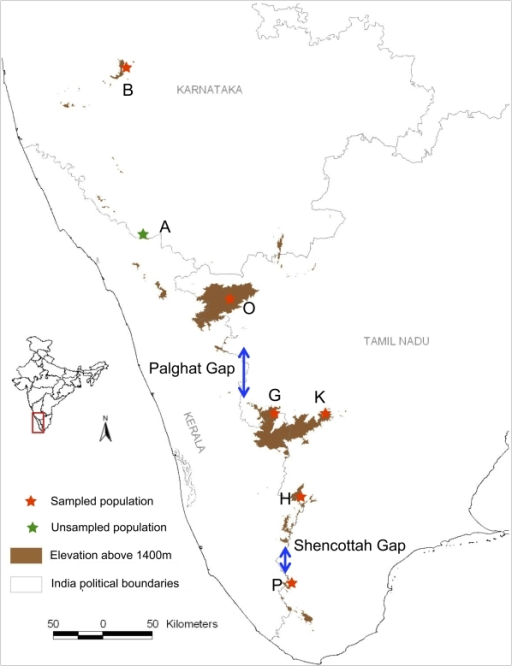
c. 40 km wide Palghat Gap serving as the major biological barrier, and the smaller Shencottah Gap, further south acting as a barrier on a smaller magnitude. The topography of the Western Ghats is relatively very old, having taken shape about 65 million years ago (Ma) (Gunnell et al. 2003). This indicates that the geographical conditions and paleoclimate was conducive for colonization of the mountains by passerine birds much before they actually arrived on the evolutionary scene 50-60 million years ago. The White-bellied Shortwing exhibits high population genetic divergence across islands, with populations on a single island being genetically similar, although ecologically isolated (Robin et al. 2010). Populations that inhabited islands across larger valleys such as the Palaghat Gap were found to exhibit far greater genetic divergence when compared to individuals across the smaller valleys. The evidence points to a pattern of colonization by these birds with two probable strategies of colonization. Ancestral individuals could have first arrived at the foothills and gradually moved up the mountains as paleoclimate varied as a result of which sightings have been mainly restricted to above 1500 mts. Another theory postulates that ancestral individuals initially colonized the first island in the sky island system and gradually hopped across islands to colonize them, as a result of which, hypothetically the oldest ancestors should be on the first island in the system. 

Image result for gaps in the western ghats
Map showing the location of the Palaghat Gap and the Shencottah Gap (Source: V.V. Robin) 


On examining the effects of genetic differentiation across populations of the white-bellied shortwing, (Brachypteryx major), on different islands of this sky island system it was observed that individuals separated by the larger, 500-million-year-old geographical genetic gap- the Palaghat Gap, were found to be genetically different from those on islands separated by smaller valleys. Genetic analysis showed significant variations in combined mitochondrial DNA genes (cytochrome b, cytochrome oxidase 1 and control region).  However populations from Grasshills and Kodaikanal showed little genetic differentiation using the same molecular markers. (Robin et al. 2010). ). It was also observed that although all three populations have similar habitat structure characterized by stunted montane evergreen Shola forests (described in Meher-Homji 1984; Shanker & Sukumar 1999), geographical isolation had lead to phylogenetic divergence over time. As a result of this divergence, two newly discovered subspecies, B. m. major and B. m. albiventris, separated by a geographical gap in the Western Ghats (Palaghat gap), with the former and latter distributed to the north and south of the gap respectively (Robin et al. 2013) were identified. Using molecular methods of sequence analysis the White-belied Shortwing was split into two subspecies, the White-bellied Shortwing, and the Rufous-bellied Shortwing. Ongoing research has provided evidence for the existence of a nest basket effect wherein deep and wide valleys serve as drivers for phylogeographic divergence, with the oldest divergences exhibited by the Palaghat Gap, while the younger divergences were seen in the Shencottah Gap and the Chaliyar valley.


However certain species failed to exhibit a pattern of divergence for which four probable patterns have been suggested. (i). Ability of species to actively disperse across these barriers, (ii). Extinction and recolonization responses to paleoclimatic changes, (iii).  Incomplete lineage sorting owing to recent divergence, (iv). recolonization during inter-glacial periods where conditions at lower altitudes were warmer compared to cooler climates at high elevations. (Robin, Vishnudas Ck, Pooja Gupta. 2015). Various inter-related factors therefore have been found to influence divergence amongst endemic birds of the sky islands. Topographical variations of the valleys, deep and wide valleys and paleoclimatic conditions have been found to serve as drivers for divergence. Further research is required to assess which of these factors impact individual species, either singly or in combination to help serve as drivers for divergence. There is a need to assess if this pattern of divergence is restricted to highly endemic specialists, or if patterns of divergence and the nest basket effect hold true for species exhibiting a broader distributional range. The outcome of such a study would be a complete phylogenetic map to the endemic birds of the Western Ghats, if not one for all the birds of the Western Ghats. This would enable detection of variations amongst inhabitants on either side of the Gaps and assess whether sub-species have been hiding in plain sight. Use of advanced molecular methods of sequencing can provide evidence for the existence of any such divergences that may not have previously been looked into. Assessment of the age of the phylogenetic divergence can serve to establish whether allopatric populations alone exhibit divergences over time or if species that have successfully colonized these sky islands before the arrival of the shortwing also exhibit divergences as a result of these geographical, genetic barriers which are ancient in their origin.


References:

i. A view from the past: shortwings and sky islands
of the Western Ghats – Robin V V, A. Sinha & U. Ramakrishnan, Indian Birds Vol. 7 No. 2 30 (Publ. 15 October 2011)

ii. Ancient Geographical Gaps and Paleo-Climate Shape the Phylogeography of an Endemic Bird in the Sky Islands of Southern India- V V Robin, A Sinha, U Ramakrishnan- PLOS One · 2013 October

iii. Deep and wide valleys drive nested phylogeographic patterns across a montane bird community, Proceedings of the Royal Society B: Biological Sciences · July 2015

iv. Determining the sex of a monomorphic threatened, endemic passerine in the sky islands of southern India using molecular and morphometric methods, V. V. Robin , Anindya Sinha,
Uma Ramakrishnan- Current Science · September 2011

v. Islands within islands: two montane palaeo-endemic birds impacted by recent anthropogenic fragmentation -ROBIN. V. V , Gupta. P et al - Molecular Ecology July 2015

vi. Singing in the sky: song variation in an endemic bird on the sky islands of southern India
V. V. Robin, Madhusudan Katti et al,  January 2013, Rare Animals of India


vii. Status and distribution of the Whitebellied Shortwing (Brachypteryx major) in the Western Ghats of Karnataka and Goa, India- Bird Conservation International · December 2006


                                                         ***********************